 ES
ES  EN
EN 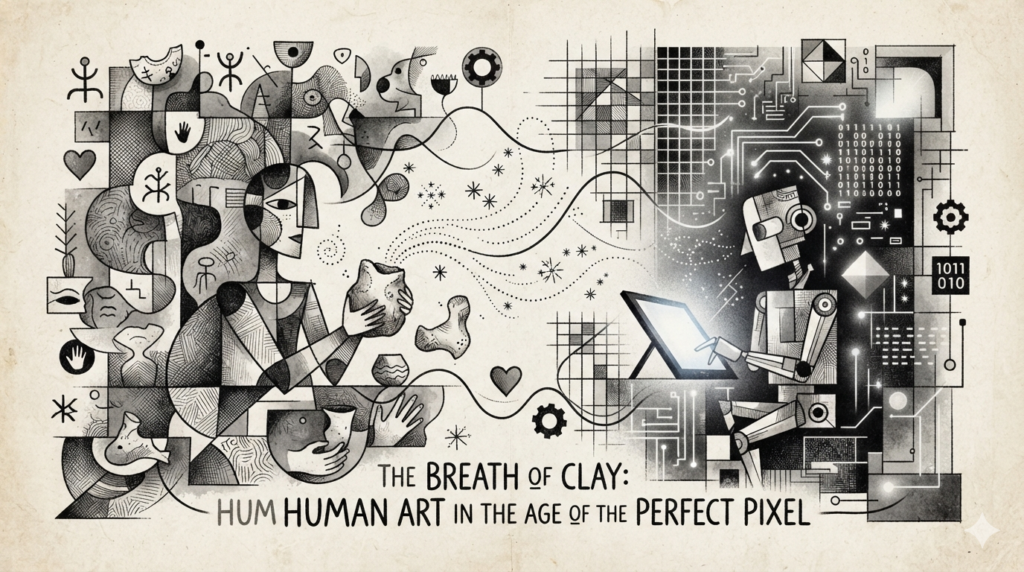
por Juan Butten
For centuries, art stood as humanity’s last unconquerable frontier. We could accept that machines would surpass us in physical strength, mathematical calculation, and logistical efficiency, but we found comfort in believing that the canvas, the musical score, and the clay belonged exclusively to the human soul. We believed creativity was a divine mystery.
Yet in 2026, digital galleries and design studios are home to a question that no longer belongs to science fiction. When an algorithm can process millions of images in seconds and produce a visually flawless work, humanity is forced to look into the mirror and ask a profound question:
What truly makes us artists?
The debate now dividing the global creative community exists somewhere between technological fascination and existential anxiety.
Can a machine create genuine art?
Supporters of Artificial Intelligence argue that AI is simply the ultimate brush—a powerful creative tool that democratizes artistic expression, allowing people with vision but without traditional technical skills to bring their ideas to life.
But skepticism continues to grow at the heart of the cultural world.
A machine does not suffer.
It does not fall in love.
It carries no trauma.
It knows nothing of mortality.
What AI produces is not art in the human sense, but an extraordinary statistical simulation—an echo without a voice, a flawless aesthetic born from emotional emptiness.
This philosophical dilemma is compounded by a legal and institutional maze that courts around the world have yet to resolve.
Who owns the rights to an image generated by Artificial Intelligence?
The engineer who wrote the code?
The user who crafted the prompt?
Or the thousands of living artists whose work was absorbed without consent to train the neural network?
Intellectual property has become a lawless frontier, where automated plagiarism often disguises itself as technological innovation, forcing traditional creators into an increasingly unequal battle for authorship, recognition, and the dignity of their craft.
Yet amid this storm of silicon and algorithms, something unexpected—and deeply hopeful—is happening.
The imperfect is fighting back.
As the internet becomes flooded with endless streams of polished synthetic imagery, collectors and audiences alike are rediscovering the irreplaceable value of art created entirely by human hands.
There is a passionate resurgence of appreciation for the texture of oil paint, the uneven trace of charcoal, the rough surface of sculpture, and the countless imperfections that no machine can truly reproduce.
Human error—once dismissed as a flaw—is now becoming one of the most valuable marks of authenticity in the contemporary art market.
Artificial Intelligence will not destroy the artist.
But it will redefine the value of creation itself.
It will remind us that art has never been about the finished object alone.
It has always been about the process.
About struggle.
About vulnerability.
About the courage to transform lived experience into something tangible.
Machines may flood the world with perfect pixels.
But as long as a human hand is willing to stain itself with paint in order to tell its own truth, art will endure.
The machine possesses calculation.
We still possess breath.