 EN
EN  ES
ES 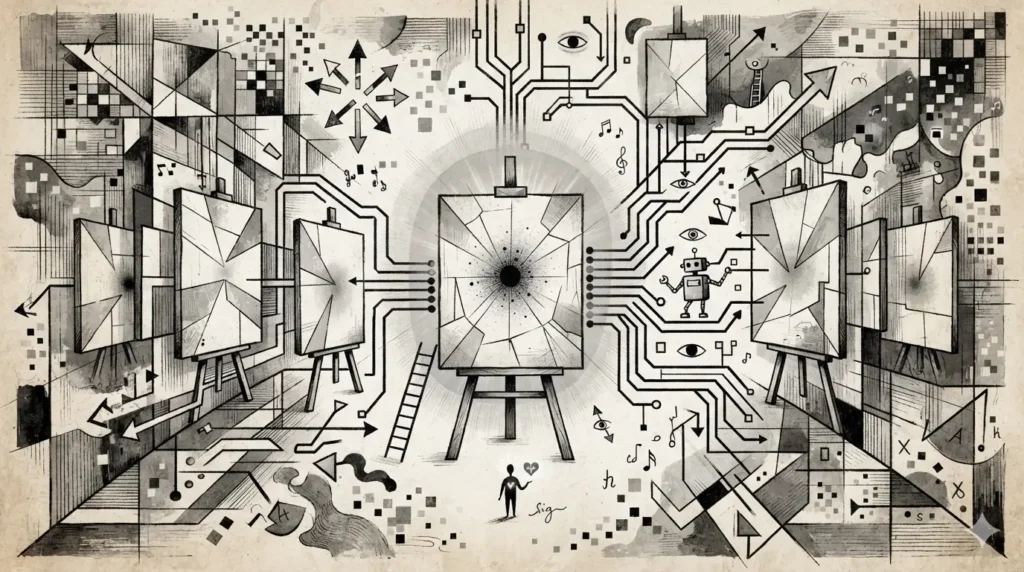
By Juan Butten
There was a time when the authenticity of a work of art was safeguarded by the immutable laws of physics. A painting was authentic because its oil paint developed cracks over the years, because the canvas preserved the painter’s fingerprints, and because there was only one place in the universe where that physical object displaced the air. Copying was a human craft—imperfect, laborious, and always revealing itself. Yet in 2026, matter has lost its monopoly. Infinite reproduction through Artificial Intelligence, high-fidelity three-dimensional printing, and the instant virality of social media have dissolved the boundaries of the real, forcing artists, philosophers, and collectors to confront an existential question: What does an original mean today?
The answer no longer resides in museums but in the redefinition of what the philosopher Walter Benjamin called the “aura.” By allowing an algorithm to clone the exact style of a master, a printer to recreate the precise texture of a brushstroke, or an image to be consumed a billion times on smartphone screens before nightfall, the digital age has beheaded the value of visual exclusivity. If the copy is identical—whether in atoms or pixels—to the original model, authenticity can no longer reside in the object’s appearance. The original has ceased to be a material condition and has become a conceptual, ethical, and institutional agreement.
This identity crisis has ignited a silent war at the heart of the art economy. For the traditional collector, infinite reproduction is a threat that devalues the market—a deafening noise that democratizes the image while diminishing its mystery. For newer generations, however, the original is no longer the physical medium but the origin of the idea: the primary file, the source code, or the human context that gave birth to the work. Value has shifted away from the object itself toward narrative and provenance. Paradoxically, the ease with which beauty can be replicated has created an insatiable hunger for genuine scarcity, where the artist’s signature and the documented record of the creative process have become the only lifeboats in an ocean of simulation.
The digital age has not destroyed authenticity—it has stripped it of its complacency. A work remains authentic today not because it is impossible to copy, but because its meaning is impossible to automate. An algorithm may clone the final result, but it cannot reproduce accident, pain, intention, or the historical context of flesh and blood. In a world where everything can be reproduced perfectly and instantaneously, the true original is no longer the canvas hanging on the wall, but the human heartbeat that chose to draw the very first line in the middle of the darkness. The machine may keep the perfect copy; the human being retains the soul of the beginning.