 EN
 ES
By Juan Butten
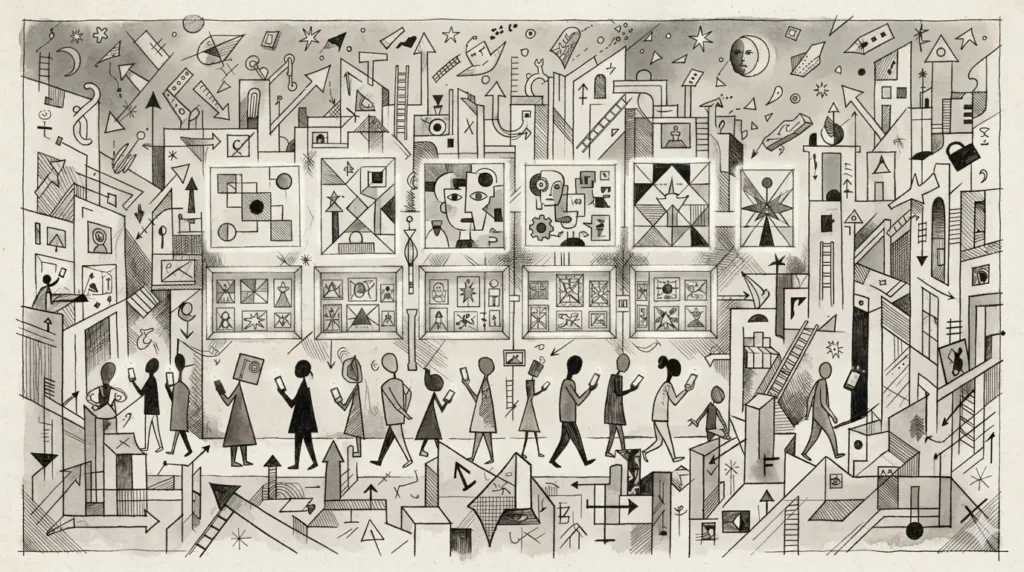
It was a Sunday in March, wandering aimlessly through the Zona Colonial, when I saw it: a crowd gathered in front of a neon replica of a Van Gogh painting, everyone with their phone raised, no one with their eyes on the painting itself. Nobody was looking at the brushstrokes. Nobody was breathing that silence oil paint once demanded as tribute. I stood still for a moment, almost uncomfortable, watching the ritual die and, in its place, only the dull flash of a smartphone shutter remaining.
I didn’t think of Adorno right away. I thought of a professor I once had, one of those who speak softly but leave a sentence lodged in you forever, who said something one afternoon in seminar that at the time struck me as an exaggeration: “the day art stops making you uncomfortable, that’s the day they’ve already lost you.” Standing in front of that neon shop window, twenty years later, I understood he wasn’t exaggerating at all.
I came to Adorno late, almost out of obligation, after reading Benjamin first — like almost everyone does. And that’s the contrast that hasn’t left my head since.
Walter Benjamin, with an optimism that today borders on naivety, believed that by tearing the work of art down from its sacred pedestal through technical reproduction, the people would claim it as their own. He imagined film and photography as tools for a beauty shared among all, capable of destroying that mystical distance — the aura — and turning it into a weapon of political emancipation. A beautiful idea, honestly. But Adorno, with his colder, more surgical gaze, saw the other side of the coin: he knew that when art loses its mystery, it doesn’t descend to earth to liberate anyone. Quite the opposite. The system absorbs it, packages it, and sells it back in convenient installments of entertainment.
While writing this, I keep thinking about how many times I’ve done exactly what I’m criticizing here: photographing a painting just to have something to post, without staying even a minute longer in front of it. That’s the trap, and it’s so quiet you don’t even notice you’ve already fallen into it.
Art’s critical potential — that capacity to unsettle us, to force us to face the cracks in our own existence — has been ground down by the machinery of the culture industry. What once created friction is now just an aesthetic backdrop for a selfie. Adorno understood something that’s still painful to admit: the technical democratization of art wasn’t liberation, it was a perfect trap. By making art identical to any other consumer product, it was stripped of exactly what made it dangerous. There’s no room left for intellectual shock. Only an endless stream of images engineered, with almost surgical precision, to generate zero friction in the brain.
Today’s viewer believes they’ve won the game because they carry the entire Louvre in their pocket. But it’s just an illusion of sovereignty, nothing more. We aren’t freer for consuming art in a massive, distracted way — we’re simply more predictable. In losing its aura, the work of art also lost its autonomy, ending up as the advertising toy of an algorithm that needs to keep us anesthetized.
Adorno warned us about this last century, and I understood it far too late, standing in front of a neon Van Gogh on some random Sunday: mass-produced art doesn’t awaken consciousness. It just decorates the walls of our own alienation.