 EN
EN  ES
ES 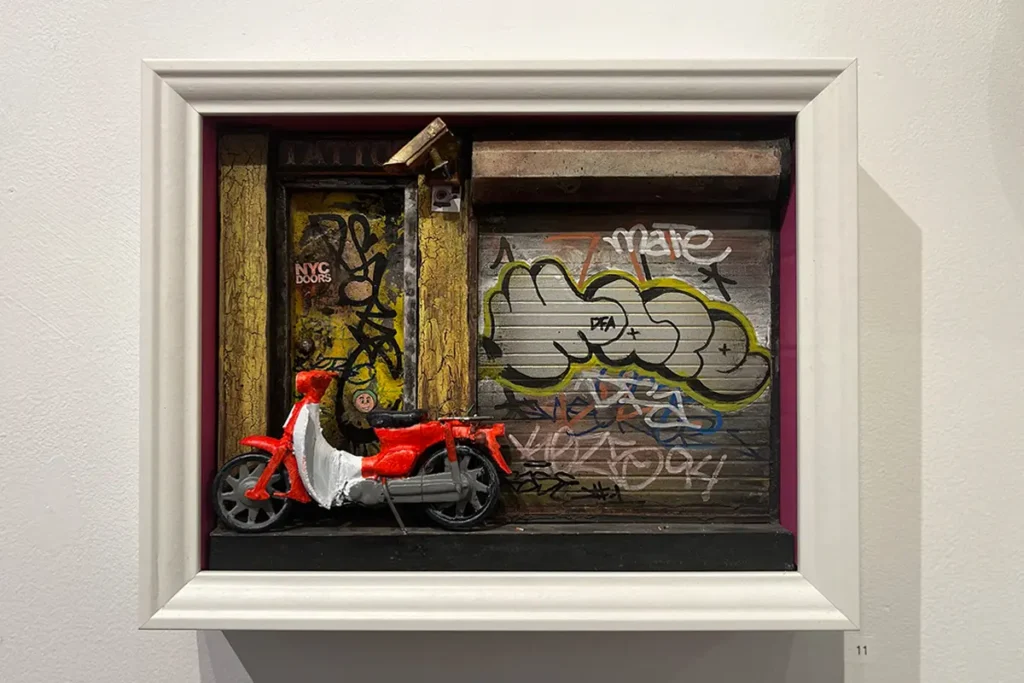
The story behind a piece of mine exhibited in Santo Domingo, Salem, and Brooklyn — and the New York writer whose tag gave it its origin.
By Juan Butten
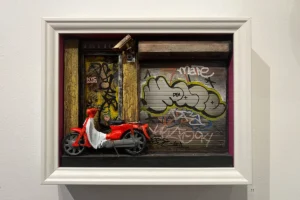
The first time I noticed the tag SABE KST was in the early 2000s, near the legendary Scrapyard store on Broadway, almost at the corner of Canal Street in Manhattan, New York. That morning, as I walked through the area, I saw the name SABE so many times that I wondered how a writer could leave his signature in so many places. I quickly realized that at least he had done it several times, because it seemed almost impossible to do so given the heavy foot traffic in that area. I decided to take a photo in front of a tattoo shop where SABE appeared alongside other famous writers.
Years later, while going through an old hard drive, I found that photo. It was during the pandemic that I began experimenting with miniatures, and that image ended up becoming a piece of its own — the starting point of a work that, without my planning it, would turn into the most direct record I have of how the real street ends up converted into an art object. Without thinking too much about it, I decided to create a piece that represented a small part of the energy of that place. After several weeks of work without pressure, as I always do, I finished the artwork. What initially started as a spontaneous tribute later became a piece I exhibited in various cities, such as Santo Domingo, Salem (Massachusetts), and finally in Brooklyn, New York.
In Brooklyn, I had the chance to meet one of the writers I had honored in my piece: SABE KST. For me, it was an enormous privilege. Thanks to his friend Nick, I was able to meet him and, to my surprise, learn more about him. It was incredible to realize that he wasn’t just a man passionate about art, but also a creator with little interest in the mainstream. For SABE, art is much more than a commodity that serves only to enrich a few. He has a very clear vision of what graffiti means, its history, the importance it holds in popular culture, and how it has influenced the world.
Graffiti was born in New York, and it was in this city where SABE grew up painting. In 1992, he began his journey in the city’s vandalism scene, fighting to earn respect and recognition among so many other writers who also wanted to leave their mark on this underground culture. A movement that, over time, faced countless legal problems, and in which many paid — sometimes with their lives — to become legends. Today, thirty years later, SABE KST remains a respected figure in the scene.
We met in a bar to talk about graffiti, culture, and everything related to this movement, which has been on the streets of New York for more than fifty years. Between laughter, drinks, and good vibes, every question I asked him received an honest answer, the kind that can only come from someone who has lived through everything they speak about. That night, I realized I had probably annoyed him with so many questions. I asked for his email, and while we continued talking, I wrote down ten questions that I later sent to him via email.
Among many things, I asked him about the meaning of his crew, KST, and his response was, “It means many things, but I prefer not to say.” I also asked him about the dozens of tags and characters still visible in the subway, and he told me that back in those days, when they went into the subway, they came out of there looking like they’d been in a coal mine. But all that sacrifice was worth it. He never regretted anything he did. He mentioned that his parents were Latino, but he preferred to speak in English because his Spanish wasn’t very good. We all laughed as he tried to speak Spanish, and Nick, from the kitchen of his house, came back with another round of drinks while I snacked on some food we had bought before heading to Nick’s apartment.
In some way, we all agreed that not everything written or painted on the streets is graffiti. Now, many who don’t belong to the culture want to call themselves graffiti artists, but what they’re really doing is muralism or what is now called street art.
Hours passed, and soon it was 2 AM. It was time to say goodbye, so I bid farewell and took the elevator down to head toward the subway station. Outside, the temperature was 30°C with a 28°C heat index. But as I walked to the station, I thought about how incredible it was that graffiti brings people together. I thought about how, over the years, the person whose tag I had photographed so many times, along with the drawing of that eerie face he had painted on the streets, was now standing in front of me. We were having a conversation as if we were old friends. I walked down the subway stairs still thinking about that face: half-erased, half-ghost, the same one I had photographed without knowing, twenty years earlier, that I’d someday end up sitting across from its author.