 EN
EN  ES
ES 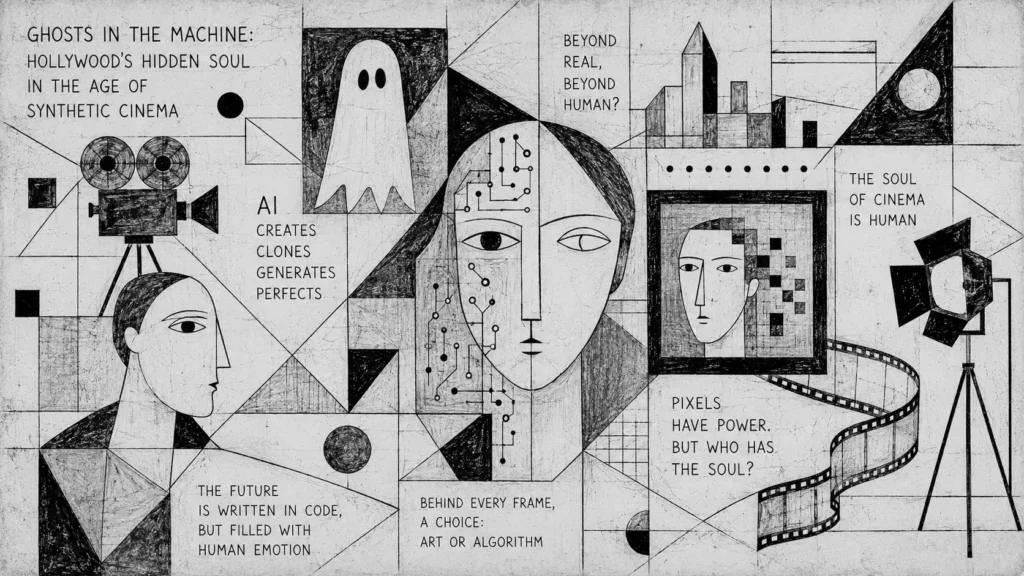
By Juan Butten
There was a time when a film’s closing credits served as a human map of its creation. Thousands of names scrolled across the screen, each one bearing witness that every shadow, every monster’s roar, and every digitally crafted tear had been born from the sweat, patience, and ingenuity of an artist.
In 2026, however, Hollywood’s editing suites are home to an invisible creator—one that never sleeps, never tires, and never collects royalties.
Artificial Intelligence has evolved from the promise of science fiction into the silent engine of Hollywood post-production, igniting a cold war over the very soul of cinema.
What is happening today inside the digital laboratories of major studios is far more than an evolution of filmmaking tools. It is a complete redefinition of the creative process.
AI no longer merely removes safety wires or cleans up imperfections in the background. It can now de-age actors in real time with astonishing photorealistic precision, clone voices while preserving subtle emotional nuances, and generate complex three-dimensional environments from nothing more than a simple text prompt.
The technical debate is largely over.
Algorithms can reduce costs and accomplish in hours what once required months of work from entire teams of visual effects artists.
Yet hidden within that technological triumph lies the question that is dividing the industry.
The real debate isn’t whether AI is efficient.
It’s whether it’s ethical.
Who owns an actor’s face when algorithms can recreate it indefinitely—even after death?
Where does the credit belong to the production designer, and where does it become plagiarism when a neural network has been trained on millions of artistic works created without their authors’ permission?
Hollywood now faces the growing danger of creative homogenization: films that are technically flawless, polished to perfection, yet stripped of the beautiful imperfections that transformed timeless classics into enduring masterpieces.
Supporters argue that Artificial Intelligence is the ultimate creative brush—a revolutionary tool capable of democratizing filmmaking and allowing directors to realize visions that were once financially impossible.
Critics see something very different.
They view AI as a corporate Trojan horse, designed to replace human creativity in the relentless pursuit of efficiency and profit.
The line separating breathtaking photorealism from synthetic illusion has become so thin that audiences increasingly find themselves asking an uncomfortable question:
Am I connecting with the talent of a performer…
…or with the calculations of a processor?
Cinema was born as a reflection of the human experience—a fusion of light, time, emotion, and imperfection.
The rise of Artificial Intelligence in post-production may be unstoppable, but Hollywood would do well to remember that technical brilliance is meaningless without a human heart beating beneath it.
Pixels can be generated by machines.
Genuine emotion cannot.
In the race to automate art, the film industry may ultimately succeed in conquering the future—only to discover that it has left its magic behind.