 EN
EN  ES
ES 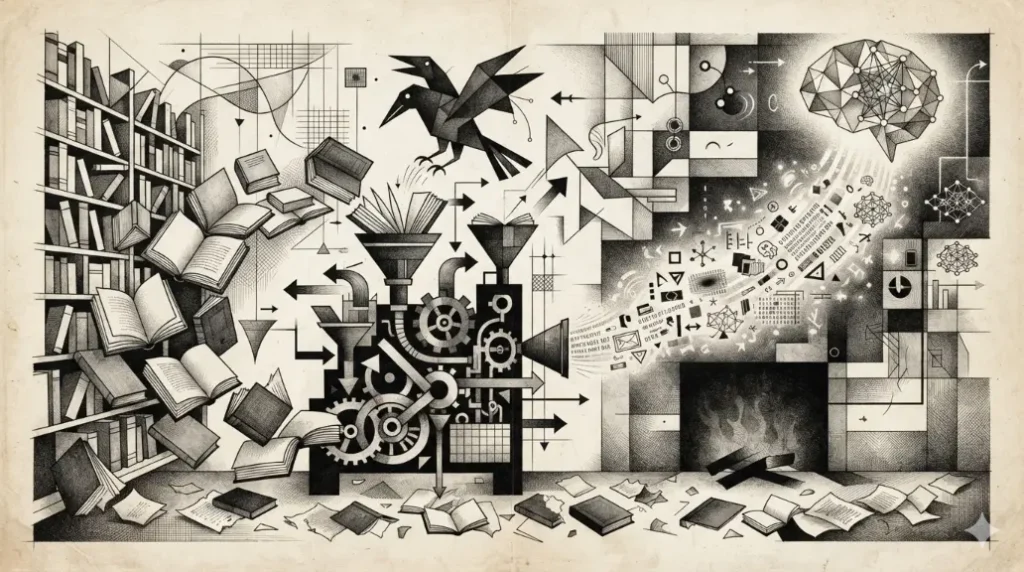
By Juan Butten
I have always considered destroying a book to be something more than an abhorrent act. Perhaps it is due to the deep love I have always had for them. I am one of those people who buys a book because of its cover design, its title, or even because it looks old and torn apart; for me, opening them has always meant entering universes where I can escape this reality, whether traveling on a guagua or a train. That is why what is happening today hits so close to home.
For centuries, destroying books was an act of power. Emperors did it to erase the memory of their enemies, dictatorships to control thought, and fanatics to impose a single truth. Every burned book represented a defeat for culture and a warning for the future.
Today, in the middle of the 21st century, the destruction of books has returned. But it no longer leaves any smoke.
According to an investigation published by the German newspaper Frankfurter Rundschau, companies dedicated to the development of artificial intelligence—including Anthropic—have reportedly acquired thousands of physical books in Europe to scan them, extract their content, and subsequently destroy the copies. Not to censor them. Not to ban them. But to turn them into fuel for algorithms.
It is a disturbing image.
The book ceases to be a cultural object and is transformed into a source of data. Once digitized, the physical volume loses its industrial utility. Its destiny is no longer a library, the hands of a reader on public transit, or a historical archive. It is recycling or the trash.
We are not facing a book burning in the public square. We are facing a silent disappearance.
The investigation argues that this strategy allows companies to obtain high-quality texts while avoiding some of the legal obstacles that exist in Europe regarding the use of works protected by copyright. The goal would be to train artificial intelligence models with carefully selected material, feeding increasingly sophisticated systems while reducing legal risk.
The reaction from the German Booksellers Association was swift. They qualified these practices as an attack on the book ecosystem and a worrying signal about the relationship between technology and culture.
And the concern goes far beyond copyright.
Because the true conflict is not solely legal. It is philosophical.
At what point does a book stop being a work and become simply a database?
Artificial intelligence needs enormous amounts of information to learn. The better the quality of the material, the better its responses will be. But behind every page lies the work of a writer who dedicated years to building a voice, a narrative structure, a piece of research, or a vision of the world.
Reducing that human effort to a set of mathematical vectors raises an uncomfortable question: are we building tools that expand culture, or industries that consume it until it is depleted?
Paradoxically, many of these companies were born with the promise of democratizing knowledge. However, the process is beginning to look more and more like cultural mining: the resource is extracted, processed, and then the original medium is discarded.
Perhaps the physical book will not disappear. It has survived the radio, television, the Internet, and the e-book. But the meaning of the book could change radically if it stops being seen as an object intended for readers and starts being considered primarily as raw material for machines.
History shows that great technological revolutions always modify our relationship with knowledge. The printing press multiplied books. The Internet multiplied access. Artificial intelligence, on the other hand, seems to be multiplying the consumption of knowledge as an industrial resource.
And that difference deserves to be discussed.
Because a society that allows its books to be treated solely as fuel for algorithms runs the risk of forgetting that before existing as data, they were written to be read, thought about, and discussed by people.
Perhaps the new battle for culture will no longer be fought in libraries or publishing houses.
Maybe it is being fought, silently, in data centers.