 EN
EN  ES
ES 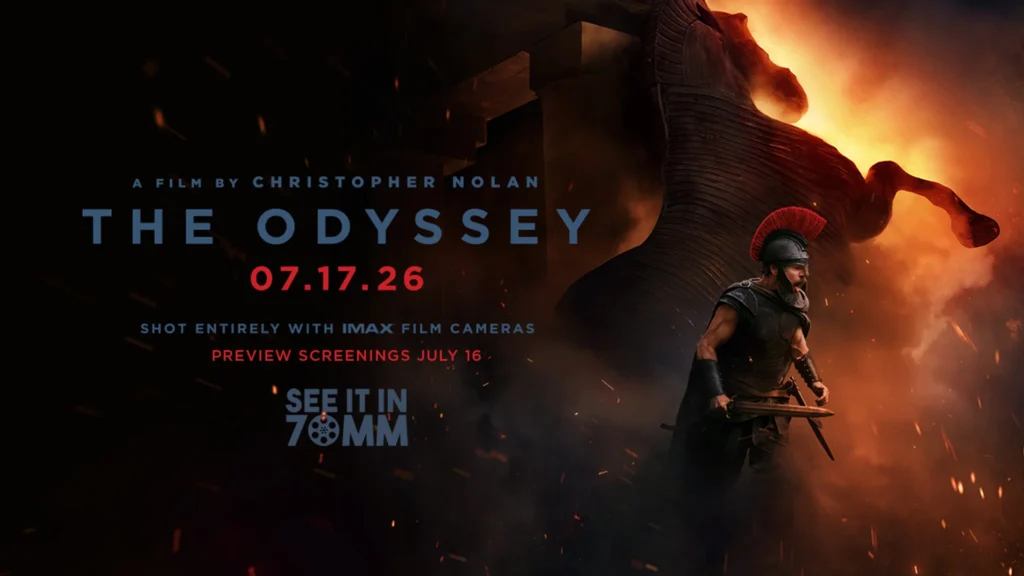
By Juan Butten
Some films are remembered for their stories. Others for the moment in which we first saw them.
For me, the first film I ever saw by Christopher Nolan will always be tied to a place that no longer exists: Videoeuropa, a video rental store in Santo Domingo where discovering cinema still meant wandering through shelves lined with VHS tapes.
People didn’t just rent movies there—they talked about them. It was a gathering place for film critics, filmmakers, film students, and devoted cinephiles who treated cinema as an endless conversation.
One afternoon, I rented Memento.
I knew almost nothing about its director. Christopher Nolan was still an unfamiliar name to most people. What I found was a film that seemed to challenge every convention of cinematic storytelling. As the narrative unfolded, I had the unsettling feeling that someone was playing with both my memory and my perception of time.
When I returned the VHS, something happened that I have never forgotten.
I ran into Armando Almánzar Rodríguez, arguably the most influential film critic the Dominican Republic has ever produced. Excited by what I had just experienced, I told him about the film. He listened quietly for a few moments before saying something that has stayed with me ever since.
“It will be very difficult for anyone to make something like this again.”
At the time, I believed he was right.
It was hard to imagine another filmmaker daring to dismantle the structure of commercial storytelling in such a radical way. What neither of us could have predicted was that this young director would go on to become one of the defining filmmakers of the twenty-first century.
More than two decades have passed since that conversation.
Since then, I have made a point of watching every Christopher Nolan film in theaters. There has only been one exception: Dunkirk. Every other film I’ve experienced on the big screen because I realized very early that Nolan’s movies are not simply meant to be watched—they are meant to be experienced.
So when The Odyssey, his adaptation of Homer’s immortal epic, was announced, I knew there was only one way I wanted to see it.
I’ll be watching it at AMC Lincoln Square 13 in New York City, one of the very few theaters in the world capable of projecting the film in its intended 70mm IMAX format.
As I wait for the lights to dim, I can’t help thinking back to that old VHS copy of Memento.
It’s remarkable to realize that the filmmaker I first discovered on a magnetic tape is now responsible for the first major feature shot entirely on 70mm IMAX film.
That journey tells its own story.
Following the global success of Oppenheimer, Nolan chose to tackle one of the foundational works of Western literature: Homer’s Odyssey.
It was hardly the easy choice.
For decades, Hollywood has attempted to revive the epic film with mixed results. Yet few productions have generated the anticipation surrounding The Odyssey. More than a new adaptation of an ancient masterpiece, it represents an extraordinary technological leap and perhaps Nolan’s most ambitious project to date.
The story itself is timeless. Odysseus struggles to return home to Ithaca after the Trojan War, spending ten years battling storms, monsters, gods, temptations, and mythical creatures while time itself seems determined to keep him away from those he loves.
But in Nolan’s hands, this journey promises to become something greater than mythology. Once again, the filmmaker appears drawn to the themes that have shaped his entire career: memory, time, identity, guilt, sacrifice, and the weight of human choices.
The revolution, however, extends beyond the story.
For the first time, a major motion picture has been photographed entirely using 70mm IMAX film cameras. Nolan has championed the IMAX format for years, using it in films such as The Dark Knight, Interstellar, Dunkirk, and Oppenheimer. Until now, however, the cameras’ enormous size and mechanical limitations made it impossible to use them throughout an entire production.
For The Odyssey, IMAX developed a new generation of cameras that are lighter, quieter, and more practical, allowing nearly every frame to be captured in the highest-resolution format available in commercial filmmaking.
This isn’t simply about making the image bigger.
Photochemical film still preserves a richness of detail, depth, and texture that digital systems continue to struggle to replicate. Nolan has long defended cinema as a physical experience, believing that certain stories deserve to unfold on enormous screens where every image can fully envelop the audience.
Perhaps that is why he insisted on shooting this epic on film instead of digital cameras.
The cast reflects the project’s extraordinary scale. Matt Damon stars as Odysseus, Anne Hathaway plays Penelope, Tom Holland portrays Telemachus, while Robert Pattinson, Zendaya, Charlize Theron, Lupita Nyong’o, Jon Bernthal, John Leguizamo, and Benny Safdie complete one of the most impressive ensembles assembled in recent years.
Yet, strangely enough, what I look forward to most isn’t meeting those characters.
What I truly want to discover is whether I’ll experience the same sense of astonishment I felt the afternoon I first watched Memento.
So much has changed since then.
Videoeuropa is gone.
VHS tapes have disappeared.
Digital cameras have replaced film.
Streaming platforms have transformed the way we consume movies.
And yet Christopher Nolan continues to defend an idea that seems almost immune to the passing of time: that cinema remains a shared experience—a ritual that begins the moment the lights go down and an enormous screen fills our entire field of vision.
In just a few days, I’ll once again take my seat before one of his films.
And perhaps, when the first frame of The Odyssey appears, I’ll hear Armando Almánzar Rodríguez’s voice once more:
“It will be very difficult for anyone to make something like this again.”
After all, perhaps he wasn’t talking only about Memento.
Perhaps, without realizing it, he was talking about Christopher Nolan himself.